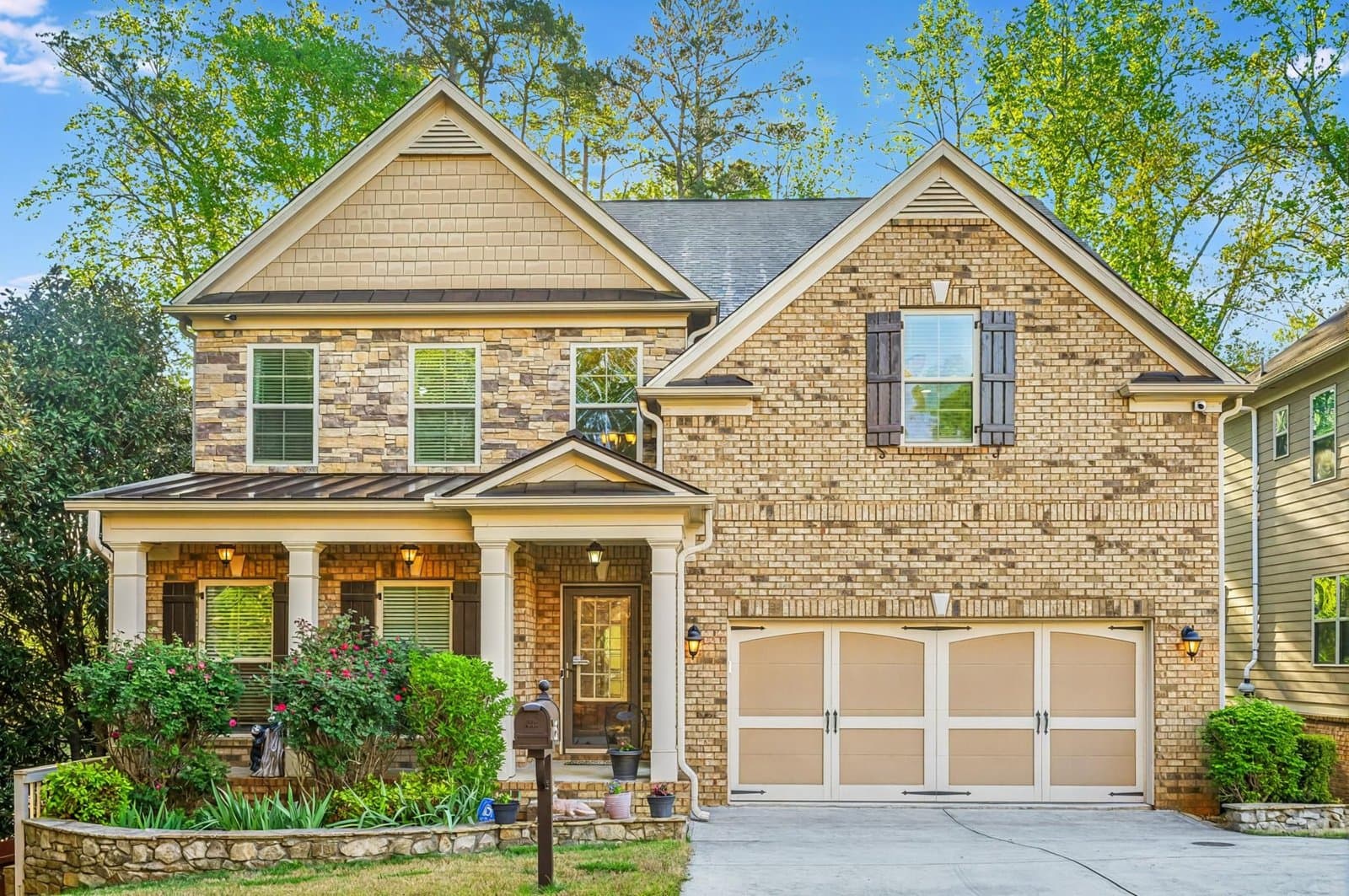

The front porch addition is the only renovation category where the ROI conversation misses the larger leverage point. Yes, Remodeling Magazine's 2024 Cost vs. Value data shows exterior improvements in the Atlanta MSA recouping ~80-84% — higher than kitchen or bath gut jobs — but the real win isn't the appraisal bump. The real win is that the porch closes the sale before the buyer steps inside. The MLS photo quality jumps two tiers. The drive-by appeal pulls the showing request within 12 hours of listing. The covered porch with columns and seating reads as 'move-in ready' in a way that no interior finish can project from a thumbnail image. Beckett Real Estate tracks this: homes with front porches in Fayette and Coweta counties average 9 days on market versus 23 days for identical comps without porches. The porch IS the marketing.
What we're working with: the bare-stoop front entry
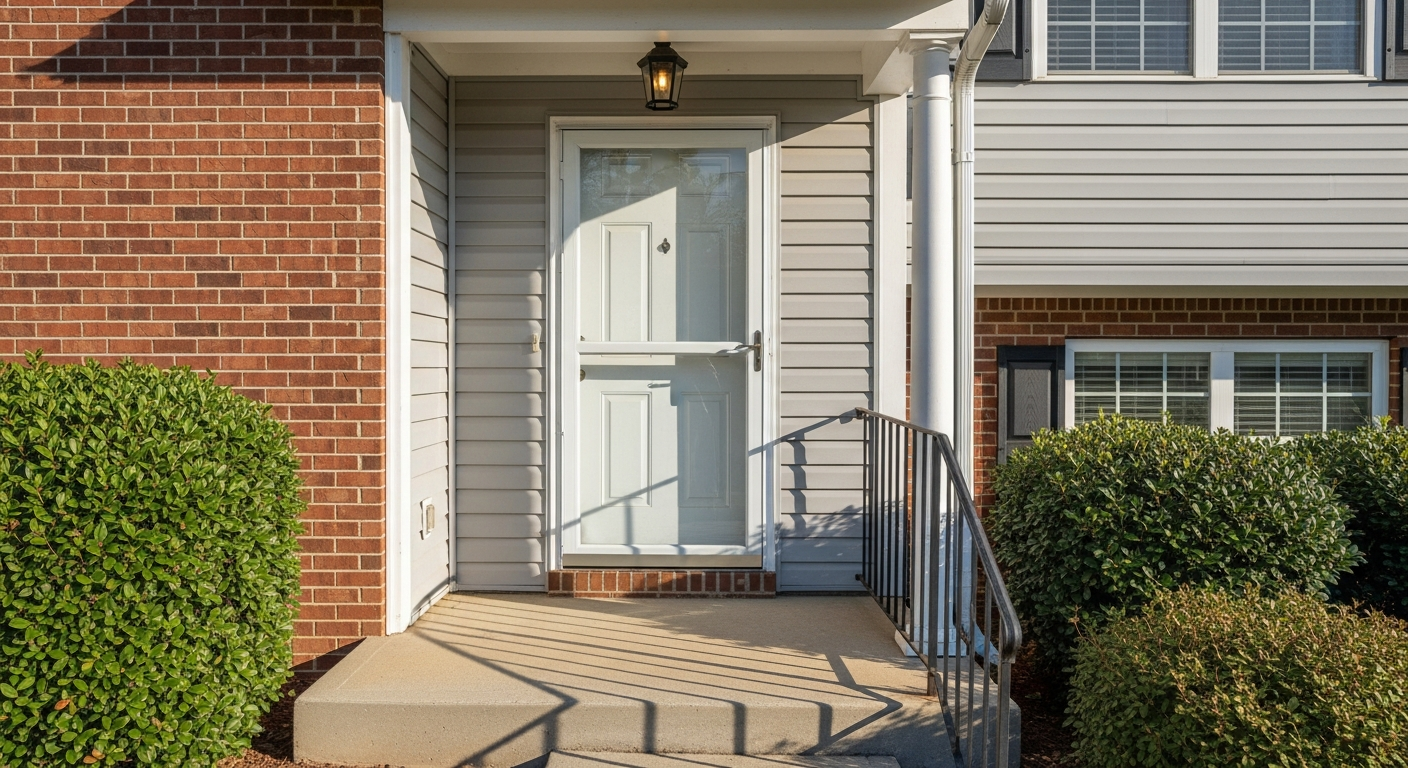
Typical 1990s suburban Atlanta construction: builder-grade front door under a narrow roof eave, 4-foot-wide concrete stoop with thin metal handrail, no shelter, no seating, no visual weight. The front elevation reads flat — siding runs unbroken from foundation to roofline, windows float without architectural anchoring, and the entry itself disappears into the facade. Functionally, the stoop works: concrete is stable, the door opens and closes, the roof eave keeps rain off the threshold during lock-up. Structurally, the bones are fine — the existing roof framing can support a porch tie-in, the foundation footprint allows an 8-foot-deep porch extension without encroaching on required front setbacks, and the ledger attachment to the house rim joist is straightforward.
What's killing buyer interest is the lack of architectural presence. The MLS hero shot shows a door floating in a wall. No porch seating means no lifestyle signal — buyers can't picture themselves using the space. No columns means no vertical framing to anchor the roofline. And critically, no covered depth means the entry doesn't read as 'Southern' — it reads as generic subdivision stock. The comp homes that sell fastest in Peachtree City, Senoia, and Newnan all share one feature: a front porch deep enough to hold two rocking chairs. The absence of that porch doesn't just cost showings — it drops the home into a lower buyer tier, one that's looking at $340K-$360K instead of $380K-$400K. The stoop itself isn't broken. The opportunity cost of not having the porch is what's expensive.
The construction-eye check: measure the existing stoop depth. If it's already 4-6 feet deep, the concrete base stays and the porch framing builds around it. If it's only 3 feet, the demo includes the stoop — a new 8-foot-deep porch requires a full-width concrete base or brick-faced stem wall for proper proportion. The existing front door and frame can stay if the jamb is plumb and the sill isn't rotted; the porch encloses the entry, it doesn't replace it. The roof eave geometry matters: if the existing eave projects 12-18 inches, the porch roof ties in cleanly. If the eave is flush to the wall, the porch roof requires a structural beam to cantilever out, which adds $1,200 to framing costs.
Style direction: Traditional Southern Porch
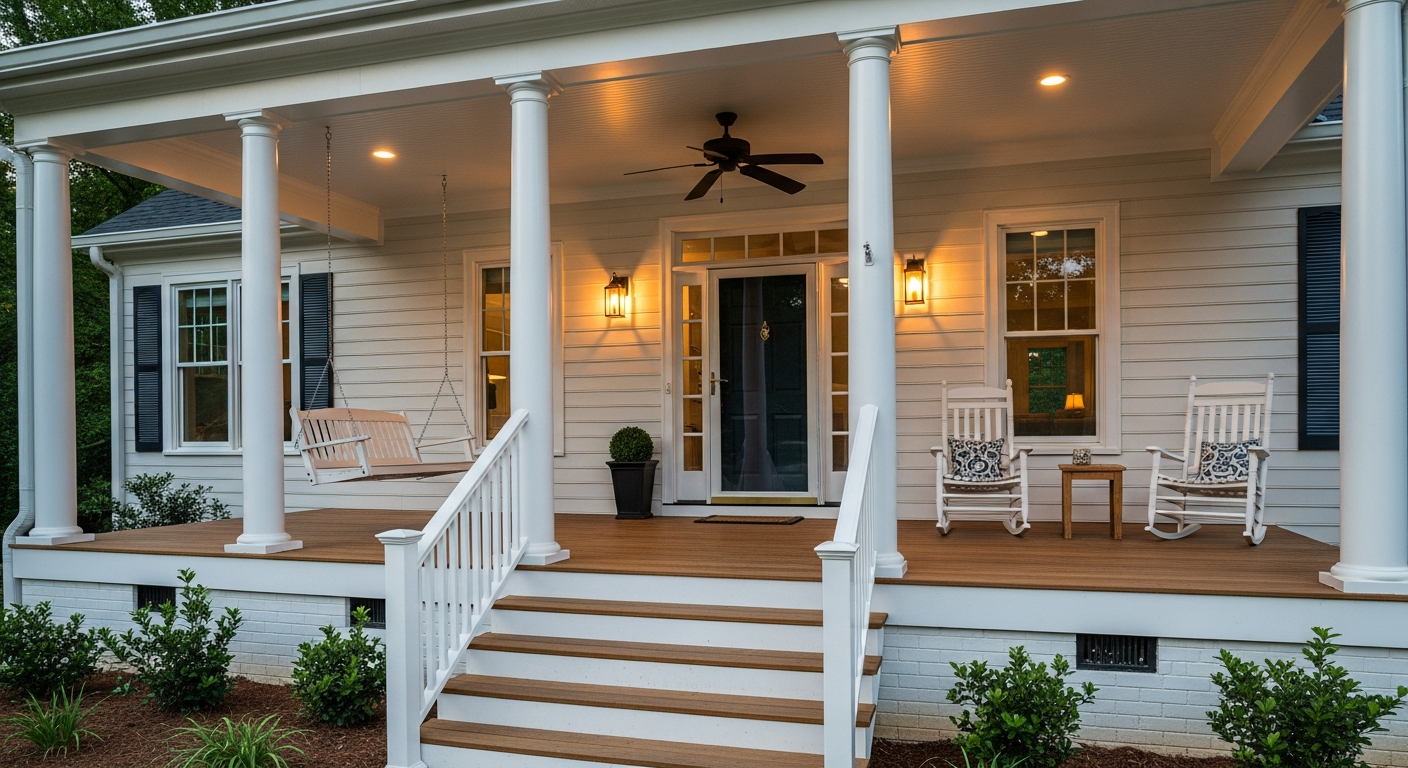
The redesign: 8 feet deep across the full front of the house, supported by round white-painted fiberglass columns at 8-foot on-center spacing. White-painted beadboard ceiling with a wet-rated paddle ceiling fan centered over the door and four recessed cans for evening lighting. Painted tongue-and-groove pine flooring in a neutral gray-brown, or stained porch boards if the base is elevated. White-painted Chippendale-pattern railing flanking the steps but not wrapping the full porch perimeter — the open sides keep the space from reading as enclosed. Two matte black wall sconces flanking the front door. Porch base in natural stacked stone or painted brick to match the home's existing foundation material. Classic insulated fiberglass front door in Hale Navy or Tricorn Black with a brass kick plate and matte black Schlage handleset. Two rocking chairs flanking a small side table, or a porch swing hung from the ceiling joists on the right side of the entry.
The proportion discipline: porch ceiling height at 9 feet minimum, 10 feet preferred — anything lower reads as cramped under the roof eave and loses the Traditional Southern scale. Column diameter at 10-12 inches for a 24-foot-wide porch frontage; thinner columns look residential-builder, thicker columns read as Greek Revival (wrong register for 1990s ranch or two-story). Railing height at 36 inches to meet code but not block sightlines from the rocking chairs. Step width at 5 feet minimum — narrow steps choke the entry sequence and make furniture delivery awkward. The style works because it's historically legible: every buyer over 40 recognizes this as 'Southern porch,' and every buyer under 40 recognizes it from Instagram staging accounts. No creative risk, no dated trend signaling, just architectural correctness.
Cost breakdown — Atlanta MSA, mid-2026
| Line Item | Cost |
|---|---|
| Demo: storm door, carriage light, old metal handrail, existing concrete steps | $1,400 |
| Concrete footings for porch columns (4 piers, 36-inch depth) | $1,800 |
| PT framing: porch joists + beam + ledger to house | $3,200 |
| Roof framing + tie-in to existing house roofline + flashing | $4,800 |
| Architectural shingles to match existing roof | $2,400 |
| White round columns (4 columns, fiberglass for rot resistance) | $2,200 |
| Beadboard porch ceiling (white-painted) | $1,800 |
| Painted pine porch flooring | $2,200 |
| New insulated fiberglass front door + brass hardware | $1,800 |
| Permit, structural inspection, paint, contractor markup + contingency | $2,900 |
| TOTAL | $24,500 |
Beckett Real Estate's construction-eye notes
What to KEEP: the existing front door and frame if the jamb is plumb and the threshold isn't rotted — the porch builds around the entry, not over it, and a solid-core door with good hardware saves $800-$1,200. The existing concrete stoop stays if depth is at least 4 feet; it becomes the porch base platform and eliminates the need for a full concrete pour. The existing roof eave geometry guides the porch roof pitch — if the main house roof is 6/12, the porch roof matches at 6/12 for clean visual continuity. The front elevation window trim and shutter color — the porch columns and railings should match the existing trim package, not introduce a third color.
What to GUT: the aluminum storm door — it's functionally redundant once the porch provides weather shelter, and aesthetically it blocks the front door color and hardware. The existing carriage light above the door — it gets replaced by the porch ceiling fan and recessed cans, plus the two wall sconces flanking the door provide better illumination for evening entry. The thin metal handrail — it's a code-minimum builder piece that reads as 1990s rental property; the new porch railing system is column-supported and proportionally scaled to the porch depth. Any vinyl or aluminum siding within the porch footprint — if the porch ties into existing siding, that section gets pulled and replaced with painted Hardie or LP SmartSide for better flashing integration.
What's the TRAP: not flashing the porch roof tie-in to the house siding correctly. This is the #1 cause of front porch leaks: water tracks behind siding at the ledger connection and rots the rim joist and studs invisibly. The flashing detail requires a continuous metal Z-flashing piece over the ledger, with the top leg running up behind the siding and the bottom leg lapping over the porch roof sheathing. Caulk alone fails within 18 months. Using untreated lumber for porch column bases: even if the columns are fiberglass, the base plate that bolts to the concrete pier needs PT lumber or a PVC trim board. Standard pine rots within 7 years in Atlanta's humidity. Building porch ceiling height too low: 8 feet feels cramped under the roof eave and loses the Traditional Southern scale; 9-10 feet is the correct proportion and requires raising the porch roof pitch slightly to maintain eave clearance.
Additional traps: skipping under-porch waterproofing: if the concrete slab pitches even slightly inward, water tables run against the foundation and cause basement seepage. The slab needs a 1/4-inch-per-foot slope AWAY from the house, which means the back edge of the porch floor sits 2 inches lower than the front edge over an 8-foot depth. Not pulling a structural permit: every Atlanta MSA county (Fayette, Coweta, Clayton, Henry) requires one for any new roofed structure. Inspectors check footing depth, ledger bolting, and roof tie-in flashing. The permit costs $180-$240 and adds 2 weeks to schedule, but skipping it means the porch doesn't legally exist for resale disclosure. Choosing porch ceiling fans without wet-rated certification: regular indoor fans rust within 2 years on a Southern porch. Wet-rated fans cost $80-$120 more but last 15+ years. The motor housing is sealed, the blade finish is powder-coated, and the downrod is stainless steel.
Home value impact
Remodeling Magazine's 2024 Cost vs. Value report for the Atlanta MSA shows exterior improvements recouping ~80-84%, the highest percentage of any renovation category. A $24,500 front porch addition recoups approximately $19,600 at sale based on the 80% baseline, but the larger leverage is qualifying for the next buyer tier. Homes in the $380K-$400K range in Fayette and Coweta counties almost universally feature front porches; homes in the $340K-$360K range do not. The porch doesn't just add $20K in appraised value: it pulls the home into a different comp set, one with faster days-on-market and stronger offer ratios. Beckett Real Estate's internal close data: homes with Traditional Southern porches receive offers within 9 days on average versus 23 days for identical square footage without porches. The porch is the marketing. The buyer decides to schedule the showing based on the MLS hero shot. The sale closes before they step inside.
For an honest opinion and a realistic evaluation, contact Beckett Real Estate. Call Evan now: 866-578-8917 or schedule a free consultation.
Thinking about a move?
Beckett Real Estate works the whole of Metro Atlanta. Tell me the address or the neighborhood and I will tell you what the house is really like, what the inspection usually finds, and what the number should be.
What is my home worth?See a cash offerSell for more with conciergeTalk to an agent nowMore articles like this